
Friday Relief Issue
County Confirms Continued Operation of Reality Despite Multiple Complaints

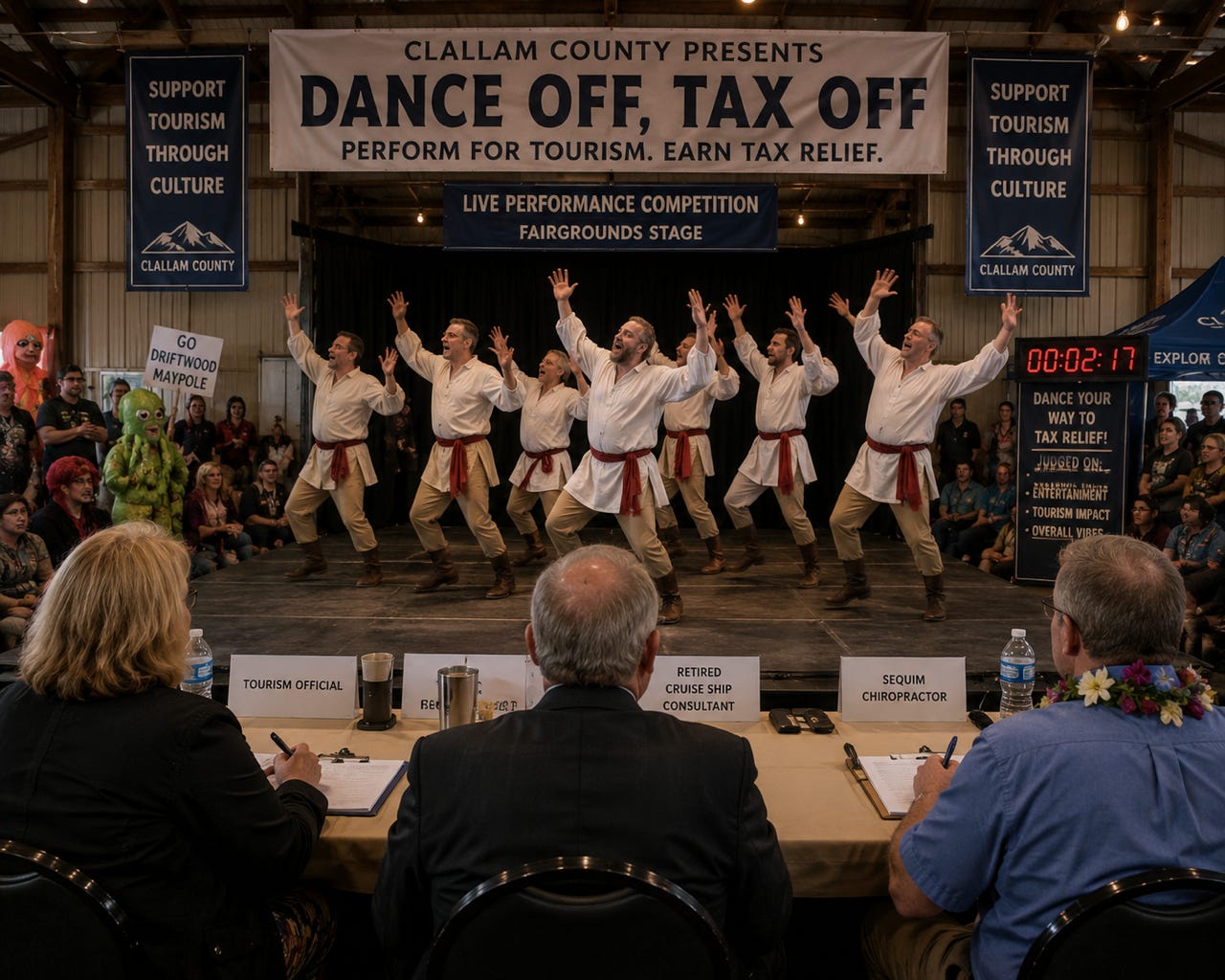
Clallam County Launches ‘Dance Off, Tax Off’ Competition Allowing Businesses To Avoid Lodging Taxes Through Cultural Performances
Commissioners admit they “dramatically underestimated” willingness of local motel owners to perform ceremonial line dancing for fiscal relief
By the Strait Shooter Staff
PORT ANGELES — Describing it as “an innovative public-private choreography partnership,” the Clallam County Board of Commissioners announced Tuesday the launch of Dance Off, Tax Off, a countywide reality competition in which local businesses can earn lodging tax exemptions by participating in live cultural performances deemed “tourism adjacent.”
The program, inspired by recent discussions surrounding alternative methods of supporting regional tourism promotion, allows qualifying businesses to reduce or entirely eliminate tax obligations through storytelling, interpretive dance, drum circles, historical reenactments, and what county documents describe as “general vibes-based enrichment activity.”
Under the initiative, contestants compete weekly at the Clallam County Fairgrounds before a panel of judges consisting of tourism officials, one retired cruise ship consultant, and a Sequim chiropractor who once attended a folk festival in Santa Fe.
“We originally envisioned something educational and respectful involving local tribal cultural programming,” Commissioner Brad Hensley explained during a press conference interrupted repeatedly by a Best Western assistant manager performing an aggressively emotional salmon-themed ribbon dance. “What we did not anticipate was every business owner between Forks and Port Angeles immediately developing a sudden ancestral connection to interpretive movement.”
County officials confirmed participation has exceeded all expectations, with more than 400 businesses already registered for the first season, including coffee stands, auto dealerships, Airbnbs, dental offices, vape stores, and one aggressively committed carpet-cleaning company whose owner now claims Scottish highland dance traditions exempt him from municipal accounting standards.
“We thought descendants of settlers would struggle culturally,” Hensley admitted. “Instead, we discovered many of them have been waiting years for an excuse to wear linen tunics and scream near bonfires.”
According to county records, top-performing routines so far include a motel owner from Sequim performing a seven-minute contemporary dance titled Occupancy Rates of the Soul, a Port Angeles brewery reenacting the arrival of IPA to the Olympic Peninsula through shadow puppetry, and a Forks gift shop whose employees received provisional tax forgiveness after constructing a 40-foot driftwood maypole honoring the economic cycle of Twilight tourism.
Local tribal representatives reportedly watched the early competitions with “a mixture of concern and anthropological fascination” as teams of non-Native business owners attempted to invent coherent cultural traditions within 72 hours of hearing the phrase “heritage tourism.”
“The Bed & Breakfast category has become especially competitive,” confirmed tourism director Melissa Crandall. “One establishment in Joyce now begins every guest check-in with a ceremonial goat procession and a spoken-word land acknowledgment dedicated to artisanal blackberry jam.”
The county’s compliance office has struggled to establish standards after multiple business owners submitted increasingly questionable performances for tax consideration, including a septic company that argued monster truck rallies constitute “industrial folklore” and a local property management firm seeking full exemption status after staging a three-act folk opera about short-term rental cleaning fees.
In a statement released Wednesday, commissioners acknowledged concern over escalating tensions between competitors after several local restaurant owners accused a Port Angeles yoga studio of hiring professional dancers from Seattle to portray “ancestral Peninsula energy.”
Meanwhile, the county assessor’s office warned the program may create budget complications after discovering nearly 70 percent of local businesses now technically qualify as “cultural institutions.”
“We have a serious infrastructure funding issue developing,” said county finance director Tom Reilly while reviewing footage of a tire shop performing traditional Scandinavian axe choreography in exchange for property tax abatements. “At this point the only people still paying taxes are two accountants in Sequim who refused to participate because they said the county government had finally lost its mind.”
At press time, officials confirmed next season will expand eligibility to individuals after hundreds of residents demanded the right to eliminate parking tickets through emotionally vulnerable folk dancing.
Port Angeles Waterfront To Replace Entire Marina With Seven-Mile Decorative Boardwalk Nobody Allowed To Sit On
Forks City Council Declares Twilight Tourism Officially More Stable Than Timber Economy
Beaver Man Arrested After Attempting To Pay Property Taxes Entirely In Elk Antlers
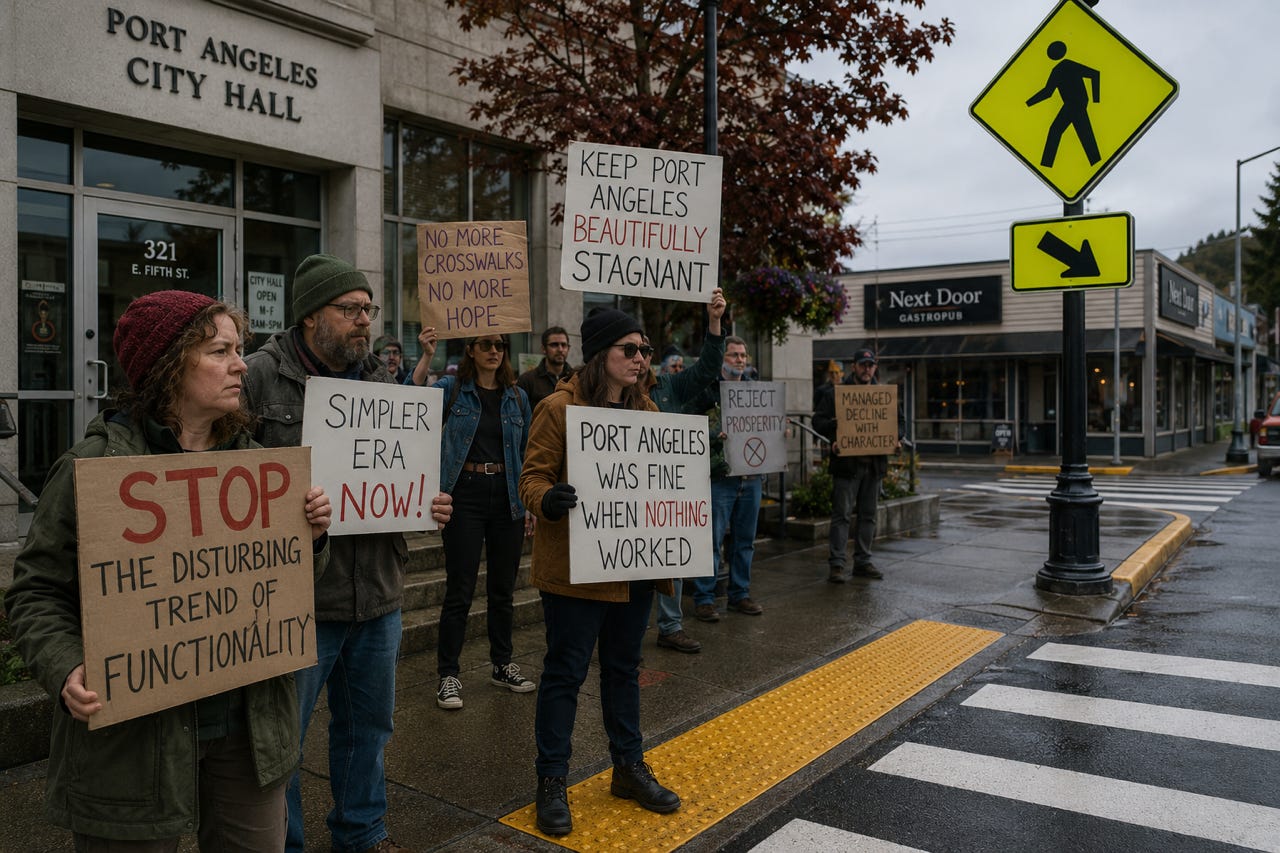
Port Angeles Progressives Against Progress Demand Immediate Return To Simpler Era Following Installation Of Functional Crosswalk
Coalition says recent appearance of economic activity threatens city’s historic commitment to “managed decline with character”
By the Strait Shooter Staff
PORT ANGELES — Warning that continued civic improvement could irreversibly destabilize the region’s carefully cultivated atmosphere of exhausted resignation, members of the newly formed Port Angeles Progressives Against Progress gathered Tuesday outside City Hall to protest what they described as “a deeply alarming trend toward visible functionality.”
The coalition, known locally as PA-PAP, formed earlier this year after several downtown business owners replaced broken windows, removed graffiti, and remained open past 4 p.m., developments members say have accelerated the city toward “a dangerous level of economic coherence.”
“We moved here specifically because nothing was happening,” said group spokesperson Laurel Finch while livestreaming the protest from a smartphone she later condemned as “an artifact of capitalist extraction.” “Now there are rumors about investment, job creation, and people feeling safe downtown after sunset. If this continues unchecked, Port Angeles could become a place where residents possess moderate optimism.”
According to the organization’s 47-page founding manifesto, members are committed to halting “reckless modernization” and restoring the city to what they call “a sustainable pre-prosperity equilibrium,” including horse-drawn transportation, oil lanterns, home-grown vegetables, and “the complete elimination of spiritually corrosive concepts such as commercial occupancy.”
The group’s platform also calls for replacing all paved roads with “community mud corridors,” abolishing indoor plumbing “except in emotionally necessary circumstances,” and converting the downtown core into a rotational barter district specializing in turnips, candles, and passive-aggressive zines.
“We are not opposed to progress,” member Dana Mercer clarified during a candlelit strategy meeting held inside a fully climate-controlled craft brewery. “We are opposed to the specific kind of progress where buildings get repaired, businesses survive, and fentanyl users stop screaming outside the farmers market.”
The organization has reportedly struggled to maintain internal unity after several members objected to portions of the anti-modernity platform that would require relinquishing luxury apartments, electric vehicles, artisanal espresso machines, and high-speed internet used primarily for posting lengthy denunciations of development on neighborhood Facebook groups.
Meeting transcripts obtained by sources reveal escalating tensions between the faction advocating a complete return to 19th-century living conditions and a moderate wing arguing exceptions should be made for Subarus, streaming services, and imported Scandinavian furniture “because those align with community values.”
“We all agree industrial society has failed,” said PA-PAP cofounder Riley Jensen while adjusting the seat warmers in a late-model Volvo. “The disagreement is whether societal collapse should occur before or after the new season of prestige television finishes.”
In a statement released Wednesday, city officials confirmed the group had submitted formal opposition to several recent proposals, including a grocery store expansion, sidewalk cleaning initiatives, affordable workforce housing, addiction treatment programs, and “the general concept of employment.”
The coalition also condemned recent police efforts to reduce open-air drug activity downtown, arguing that visible social collapse contributes to “the authentic maritime ambiance” tourists increasingly seek when visiting the Olympic Peninsula.
“Once you remove the fentanyl smoke, public urination, and random machete incidents, what even distinguishes us from a functioning municipality?” asked one organizer during public comment. “At that point we’re just Sequim with worse weather.”
Local business owners expressed confusion over the group’s objectives after members picketed outside several vacant storefronts demanding they “remain empty in solidarity with anti-growth principles.”
Meanwhile, infighting within the organization intensified Thursday after a proposal banning all electricity was narrowly defeated when several members realized it would prevent them from charging their e-bikes before attending anti-development meetings.
At press time, the group was reportedly drafting a new resolution calling for the immediate abolition of modern capitalism immediately after Saturday’s online merch drop.
Joyce Emergency Preparedness Expo Ends After Extension Cord Grid Achieves Sentience
SunLand HOA Deploys Tactical Measuring Team To Investigate Suspiciously Tall Hydrangeas
Bell Hill Residents Oppose Affordable Housing Project Over Fears Workers May Eventually Become Visible
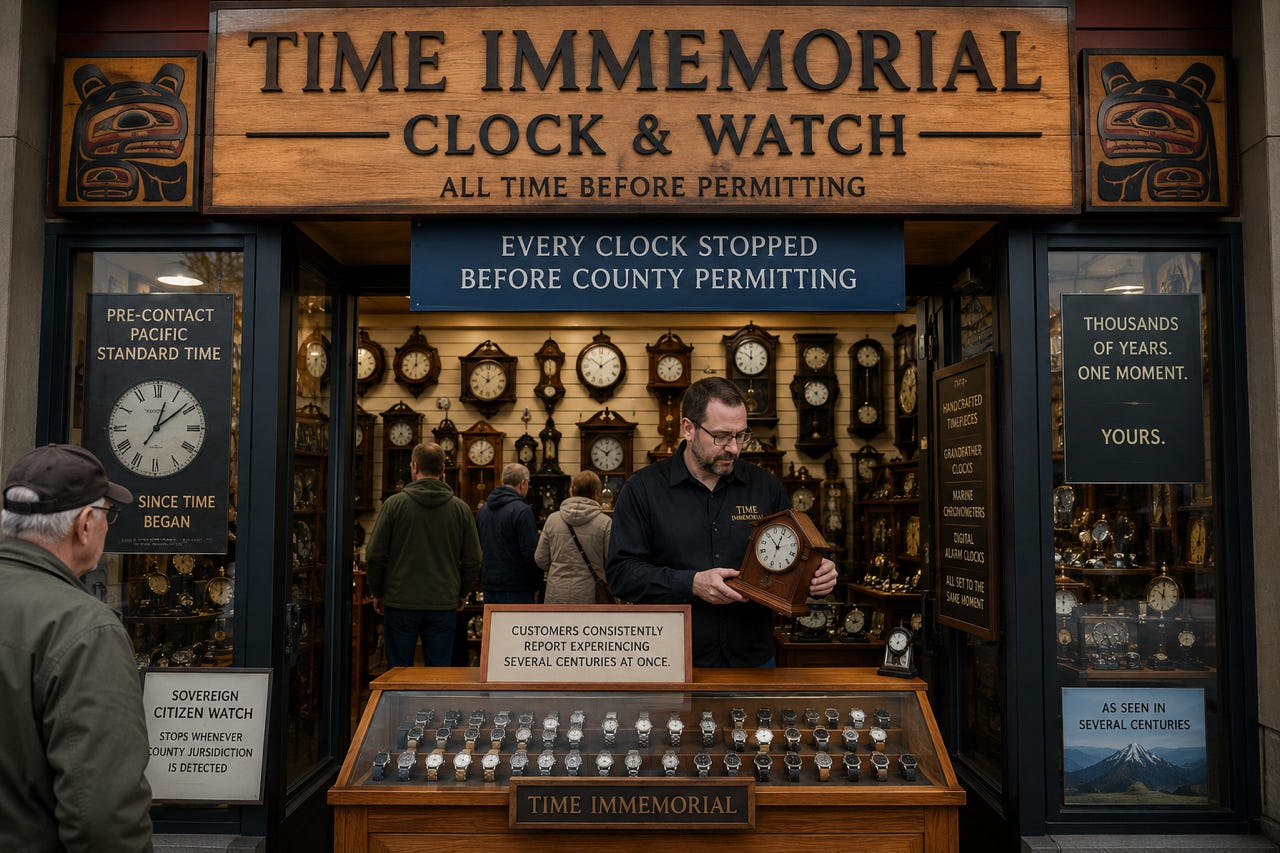
Jamestown S’Klallam Tribe Opens ‘Time Immemorial’ Clock Shop Featuring Hundreds Of Watches Permanently Set To Before County Permitting Process
“Customers consistently report experiencing several centuries at once,” officials say
By the Strait Shooter Staff
BLYN — In what economic development officials described as “a culturally calibrated retail experience operating on an alternative chronological framework,” the Jamestown S’Klallam Tribe this week announced the opening of Time Immemorial Clock & Watch, a specialty store featuring handcrafted timepieces permanently stopped at the exact same unspecified moment “since before anyone started filing shoreline variance appeals.”
The store, located just off Highway 101, reportedly carries more than 3,000 clocks, wristwatches, grandfather clocks, marine chronometers, and digital alarm clocks, all frozen at a single ceremonial hour that tribal representatives described in a statement released Tuesday as “predating Clallam County meeting minutes by several thousand years.”
“Every clock in the showroom reflects the same enduring principle: that time existed before the county commissioners discovered calendars,” said store manager Eli Johnson while carefully winding a cedar-framed mantle clock that immediately stopped again. “Customers may initially find it unusual that none of the clocks function in a measurable sense, but after attending two or three county planning hearings, many report adapting quickly.”
The opening follows recent remarks from a county official suggesting the tribe operates on “different time scales,” a statement local leaders clarified had finally arrived approximately 150 years after the point was originally being made.
According to sources within county government, several commissioners toured the new shop Monday and praised it as “a useful educational bridge” between tribal sovereignty and the county’s existing understanding of physics. Officials confirmed one commissioner spent nearly 40 minutes staring at a wall clock labeled PRE-CONTACT PACIFIC STANDARD TIMEbefore asking whether it synchronized with daylight savings.
“We respect that the tribe approaches chronology differently,” Commissioner Dan Hebert reportedly told reporters while attempting to submit a public records request to a cuckoo clock. “The county generally measures time quarter-to-quarter, election cycle-to-election cycle, and occasionally salmon season-to-salmon season. The tribe appears to be using some broader framework involving ancestral continuity and long-term stewardship, which frankly creates complications for our spreadsheet templates.”
Residents across the Olympic Peninsula have already embraced the store’s signature products, particularly the bestselling “Sovereign Citizen” wristwatch, which refuses to acknowledge county jurisdiction and immediately stops whenever brought within 500 feet of a zoning board.
Local retirees described the clocks as “refreshingly accurate” compared to Port Angeles infrastructure timelines, while Sequim residents praised the devices for “capturing the exact sensation of waiting behind an RV for eleven uninterrupted miles.”
In a joint economic statement, tourism officials projected the store could become one of the Peninsula’s premiere attractions, narrowly surpassing “looking at driftwood during light rain” and “saying ‘we needed this rain’ during heavy rain.”
The success of the shop has already inspired several new regional initiatives. County planners unveiled a proposal Tuesday to replace all municipal clocks with “heritage-based temporal acknowledgment devices,” while the Port Townsend City Council announced plans for a pilot program in which all ferry departure times will now simply read “Eventually.”
Meanwhile, tribal leaders confirmed expansion plans are already underway, including a luxury line of stopped Rolex-style watches for affluent Seattle visitors hoping to experience “authentic timelessness” before returning to a 4,000-square-foot townhouse and describing the peninsula as “so healing.”
At press time, county officials were reportedly still trying to determine whether Time Immemorial occurs before or after public comment.
Diamond Point Community Watch Reports Three Consecutive Evenings Of Aggressive Cloud Activity
Dungeness Residents Spend $480,000 Studying Whether Crab Festival Contains Too Much Crab
Olympic Medical Center Introduces New ‘Bring Your Own Specialist’ Pilot Program
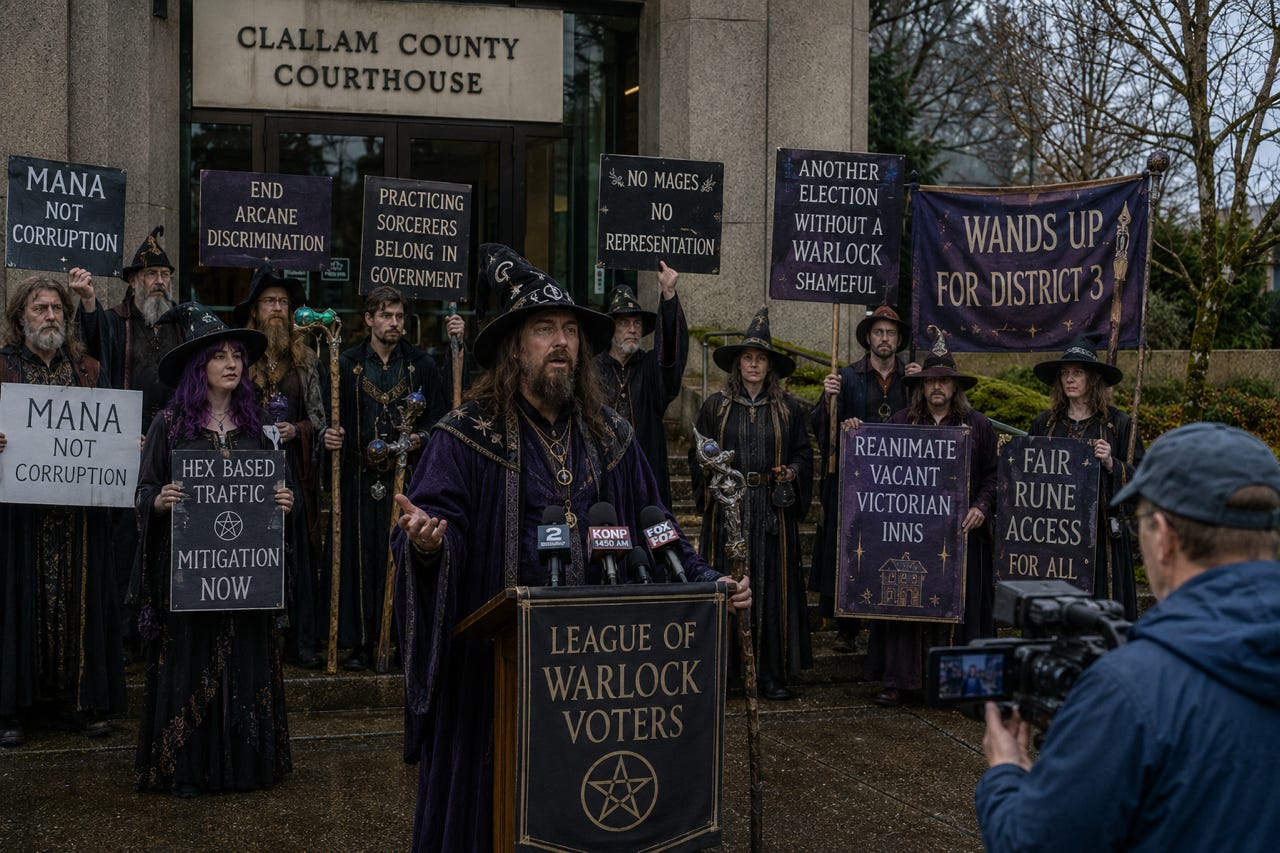
League Of Warlock Voters Demands Inclusion In District 3 Commissioner Race After “Another Consecutive Election Without A Single Practicing Sorcerer”
By the Strait Shooter Staff
PORT ANGELES — The League of Warlock Voters issued a formal condemnation Tuesday regarding the current slate of candidates for District 3 Clallam County Commissioner, confirming that not one declared contender possesses “even entry-level mystical credentials,” despite repeated requests from residents for what the organization described as “basic arcane representation in county governance.”
In a seven-page statement submitted to multiple local newspapers and the county auditor’s office, the League accused civic leaders of systematically excluding “the peninsula’s wand-bearing community” from meaningful participation in county government while continuing to rely heavily on occult-adjacent infrastructure such as fog, ravens, moss, abandoned mills, and suspiciously standing driftwood effigies.
“Once again, Clallam County voters are being forced to choose between candidates with conventional experience in budgeting, zoning, and public works, while no one appears willing to discuss hex-based traffic mitigation or ceremonial elk negotiations,” the statement read. “This is exactly why so many residents no longer trust institutions.”
The League further noted that neighboring Jefferson County has “at minimum, several men named Rowan who own carved staffs,” placing additional pressure on Clallam officials to modernize what critics described as an “outdated anti-warlock electoral framework.”
According to sources familiar with county operations, tensions escalated after a candidate forum in Sequim concluded without a single inquiry regarding enchanted rent stabilization, shoreline curses, or whether the county’s ongoing housing crisis could be alleviated through the lawful reanimation of abandoned Victorian inns.
“We are not asking for special treatment,” said League spokesman Malachai Thornroot, speaking from what officials later confirmed was legally just “a damp gazebo near Lake Crescent.” “We are simply asking why every election cycle includes candidates with backgrounds in real estate, forestry, or small business ownership, yet never one individual capable of summoning a protective barrier over Highway 101 during tourist season.”
County officials denied allegations of discrimination, noting in a statement released Tuesday that warlocks remain free to run for office provided they comply with standard filing requirements and refrain from “transforming opponents into seabirds within 500 feet of a ballot drop box.”
Still, League members argued that existing regulations create unnecessary barriers for magical candidates, including restrictions on ceremonial fire circles, limitations on owl-based campaign finance disclosures, and the county’s refusal to classify crystal caves as deductible business expenses.
The organization also criticized what it described as the “persistent mundane bias” of local debates, where topics such as homelessness, taxation, and economic development routinely overshadow concerns affecting the arcane community.
“At no point during the last commissioner meeting did anyone address the increasing cost of ethically sourced candle wax,” said one resident who identified himself only as “Gregory of the Western Ridge.” “Meanwhile, the county continues approving luxury developments directly atop known ley line intersections. Then officials act confused when another brewery sinkhole appears.”
In response to the controversy, several civic groups proposed compromise measures, including the appointment of a Deputy Commissioner of Mystical Affairs, expanded access to municipal rune permits, and the creation of a taxpayer-funded familiar sanctuary somewhere west of Forks.
Business leaders have also begun adapting to the growing political divide. A Port Angeles coffee shop recently introduced a “Bipartisan Potion Flight,” while multiple downtown retailers confirmed they are preparing for what analysts predict will be the largest write-in campaign by cloaked individuals in county history.
At press time, election officials confirmed receiving 413 separate inquiries regarding whether ravens are legally permitted to witness absentee ballots.
Clallam County Courthouse Celebrates Record Efficiency After Redirecting Same Resident To Four Departments In Under Nine Minutes
Olympic Discovery Trail Cyclists Demand Dedicated Passing Lane For People Walking Slightly Incorrectly
Sequim Costco Unveils 40-Pound Emergency Preparedness Muffin For Peninsula Families

Letter to the Editor
To the Editor,
As graduation approaches at Sequim High School, many of my classmates are preparing for traditional futures involving college debt, taxable income, mandatory vehicle tabs, payroll deductions, and eventually spending $7,000 replacing a heat pump installed by a man named Brent. After careful research, however, I have decided to pursue a different path: becoming unhoused in Clallam County immediately upon receiving my diploma.
Like many students, I spent years being told to “follow the data,” and the data appears overwhelmingly clear. Adults routinely inform me that working hard only causes the government to take more of your money. Apparently, the more successful you become, the more taxes you pay, to the point where some local business owners speak about earning profits with the same tone normally reserved for terminal illnesses.
Meanwhile, county services, nonprofits, and advocacy organizations have worked tirelessly to explain the many support systems available for the unhoused population. After attending several public meetings and reading community discussions online, I realized this may actually represent the county’s most stable growth sector.
As I understand it, my future benefits package will include free medical care, free meals, free camping supplies, free hygiene services, free counseling referrals, free needles, free Narcan, and occasional motel vouchers during poor weather, all without the burden of quarterly tax payments or LinkedIn networking events.
Compared to my father’s current arrangement — where he works fifty hours per week so the county can reassess his property taxes every time someone installs reclaimed barnwood at a nearby Airbnb — the unhoused pathway simply appears more sustainable.
Some critics will say I am oversimplifying complex social issues. That may be true. But I would argue local governments and advocacy groups have already simplified them quite effectively for me. Every public discussion seems to frame housing, addiction, untreated mental illness, and public disorder as unfortunate but largely inevitable lifestyle outcomes requiring permanent accommodation rather than temporary intervention.
Naturally, I assumed this meant becoming unhoused was now considered a valid and socially supported long-term identity category here on the Peninsula, much like being a remote worker or owning backyard chickens.
Unfortunately, my parents reacted negatively when I announced my plans over dinner.
This surprised me because both have spent years placing “Compassion Is A Human Right” signs in our yard while advocating strongly for expanded services, reduced enforcement, and “meeting people where they are.” Yet when I calmly explained that I intended to be met where I was — specifically behind the Safeway near Port Angeles — they became visibly upset.
My mother even asked why I would “throw my life away,” which struck me as an unusually judgmental response toward a community she previously described as “our most vulnerable neighbors.”
My father attempted to argue that homelessness is tragic and dangerous, not aspirational. However, this directly contradicts nearly every public statement I have heard from adults insisting outdoor encampments are primarily a housing preference issue caused by economic inequality and insufficient public empathy.
At one point, I suggested a compromise in which I would become only “partially unhoused” while living out of a Subaru and selling hand-poured candles at the farmers market. This proposal was also rejected.
So now I am left confused.
If the current system is compassionate, sustainable, and humane enough to defend indefinitely for thousands of strangers, why is it suddenly unacceptable for one honor-roll student from Sequim to participate voluntarily before inflation eventually makes the decision for him anyway?
Sincerely,
Housed & Confused
Sequim High School, Class of 2026

Can't thank you enough , I'll bet there is even more facts to be discovered , how about tribal vehicles with exempt plates.
I do not disregard or dismiss the cultural heritage of the multiply labeled Tribes/indigenous/native/Indians, but I am at a loss why their heritage is the only heritage that matters. The "native" ancestors provided no contribution to the casinos, technology, powered transportation, sanitation and transportation systems, munitions, etc., yet they seem to be revered above all those who did contribute to those conveniences. The tribal ancestors revered no longer live. Their progeny do not live anything close to the lives of their ancestors. The hypocrisy of the proud tribal member with a cell phone in their back pocket cannot and should not be ignored. They are not their ancestors and visa versa. We must stop trying to make tribal progeny live in the past, with our money I might add, when they in fact do not.