
The Peninsula Progress Update: Plans Within Plans
Because if one plan doesn’t work, several overlapping ones should do the trick


County Unveils “Seagull Integration Strategy” to Reframe Ongoing Street Issues
Officials say public tolerance may improve if behavior is rebranded as coastal wildlife activity
By the Strait Shooter Staff
CLALLAM COUNTY — In what leaders are calling a “perception-first solution,” county officials this week introduced a pilot program aimed at reducing public complaints by reclassifying a visible street-level problem as something residents are already accustomed to ignoring: seagulls.
The initiative, formally titled the Urban Seagull Integration Strategy, proposes outfitting select unhoused individuals with lightweight gray-and-white ponchos, optional wing attachments, and what one internal document describes as “confidence to occupy space like a bird that fears nothing.”
“Look, people here have made peace with seagulls,” said one official during a briefing. “They loiter. They take things that aren’t theirs. They leave messes in high-traffic areas. And yet, nobody calls a town hall meeting about it. That’s the model.”
A Familiar Presence, Reimagined
Under the proposal, participants in the pilot program would be encouraged to adopt seagull-adjacent behaviors already considered socially tolerable along the waterfront and downtown corridors.
Guidelines reportedly include:
Standing in groups near food sources while maintaining a sense of entitlement
Approaching pedestrians with sudden, unpredictable movements
Treating public infrastructure as both habitat and restroom
“Consistency is key,” said a program coordinator. “If it looks like a seagull situation, people mentally file it as a seagull situation. We’re working with that reflex.”
Public Reaction
Early reactions from residents have been mixed, with some expressing confusion about whether the program is real, while others admit it may be the first policy proposal that aligns with observable reality.
“I mean… I already avoid both the same way,” said one local. “Eye contact minimal, protect your food, keep moving.”
Others raised concerns about long-term effectiveness, noting that while seagulls are tolerated, they are not necessarily appreciated.
“That’s the part they’re skipping,” another resident said. “People don’t like seagulls. We’ve just accepted defeat.”
Implementation Challenges
Officials acknowledged potential complications, including increased competition with actual seagulls, unclear jurisdiction over “avian-coded individuals,” and the possibility that the public may begin demanding similar rebranding efforts across other problem areas.
There are also logistical questions about enforcement.
“If someone refuses to participate, are they non-compliant or just… not a bird?” one staff member reportedly asked during a planning session.
Looking Ahead
Despite the uncertainties, county leaders remain optimistic that the program could serve as a template for future policy innovations centered on perception management rather than direct intervention.
“We’re not saying this solves anything,” an official clarified. “We’re saying it might make it feel like less of a problem.”
At press time, several actual seagulls were observed circling a downtown trash can, aggressively asserting dominance over a situation no one appeared willing to address.
Dungeness Residents Warned Spit May Curve Differently Pending State Alignment; Lighthouse Asked to “Stay Flexible”
Joyce General Store Bulletin Board Achieves Sentience, Begins Rejecting Unapproved Thumbtacks
Diamond Point Installs Official Strait-Watching Hours; Unauthorized Gazing Now Considered Premature Observation

Library System Invests $50,000 to Discover Same Ten People Still Willing to Attend Fundraiser
By the Strait Shooter Staff
CLALLAM COUNTY — In a bold and visionary move to secure its financial future, the regional library system announced last year that it would be hiring a professional fundraising consultant for the modest fee of $50,000. The goal: to dramatically expand donor engagement, energize the community, and, ideally, introduce at least one new human being to the annual library fundraiser.
After months of strategic planning, stakeholder interviews, branding exercises, and what sources described as “an alarming number of PowerPoint decks,” the results are finally in.
The fundraiser was held last Thursday.
Ten people attended.
“It’s incredibly affirming,” said Library Director Marlene Fitch, gesturing toward a familiar cluster of folding chairs occupied by the same loyal attendees who have sustained the event since approximately 2008. “What we’re seeing here is consistency. You can’t buy that kind of retention.”
Ironically, they did.
The consultant’s final report, delivered in a 47-page document titled Reimagining Community Philanthropy Through Narrative Alignment, recommended several bold innovations. Among them: renaming the event from “Library Fundraiser” to “An Evening for Literacy,” slightly dimming the overhead lights, and replacing the store-brand cookies with what one attendee described as “the same cookies, but arranged diagonally.”
Attendee #4, who asked to remain anonymous but is widely known to staff as “Gary with the hat,” praised the changes. “It feels elevated,” he said, nibbling on a diagonally positioned oatmeal raisin. “Last year, the cookies were more… orthogonal.”
Despite these enhancements, attendance—and giving—remained stable.
“We’re proud to report that donations held steady at $312,” said Fitch. “That’s a number our community really believes in.”
Several attendees expressed satisfaction with their contributions, noting that $20 “used to go a long way” and should, in principle, still do so if managed responsibly. One guest was overheard asking whether the library had considered “simply buying fewer books” as a cost-saving measure.
Experts confirm that while inflation has affected nearly every sector, the fundraiser’s core donor base has remained admirably committed to economic conditions last observed during the early Obama administration.
Meanwhile, critics have pointed out that the library system itself may be operating under similarly vintage assumptions — specifically, that a modest increase in local taxes will seamlessly cover funding gaps, rather than requiring a fundraising strategy that aspires to numbers exceeding what can be collected from ten people and a tray of geometrically adventurous cookies.
City officials have expressed cautious optimism.
“Sure, we spent $50,000 to learn that Gary was going to come no matter what,” said Councilmember Diane Rusk. “But now we know it with data. And if we can just pass a levy, we can keep this entire operation running indefinitely without ever having to ask Gary for more than $20.”
To justify the consultant’s fee, the report also included a number of forward-looking recommendations, such as “leaning into storytelling,” “activating cross-channel synergy,” and “exploring the emotional journey of shelving books.” A pilot initiative involving interpretive dance in the biography section is reportedly under consideration.
At press time, the library system announced it is exploring the possibility of hiring a second consultant to evaluate why the first consultant’s recommendations failed to increase attendance, noting that “this kind of deep insight doesn’t come cheap.”
Bell Hill Roundabout Develops Personality, Refuses Exit to Drivers Exhibiting “Unsanctioned Confidence”
Sequim Lavender Fields Reassigned as Calmness Infrastructure; Bees Issued Tiny Compliance Vests
Happy Valley Chickens Begin Self-Reporting, Submit 42-Page Manifesto on Coop Autonomy
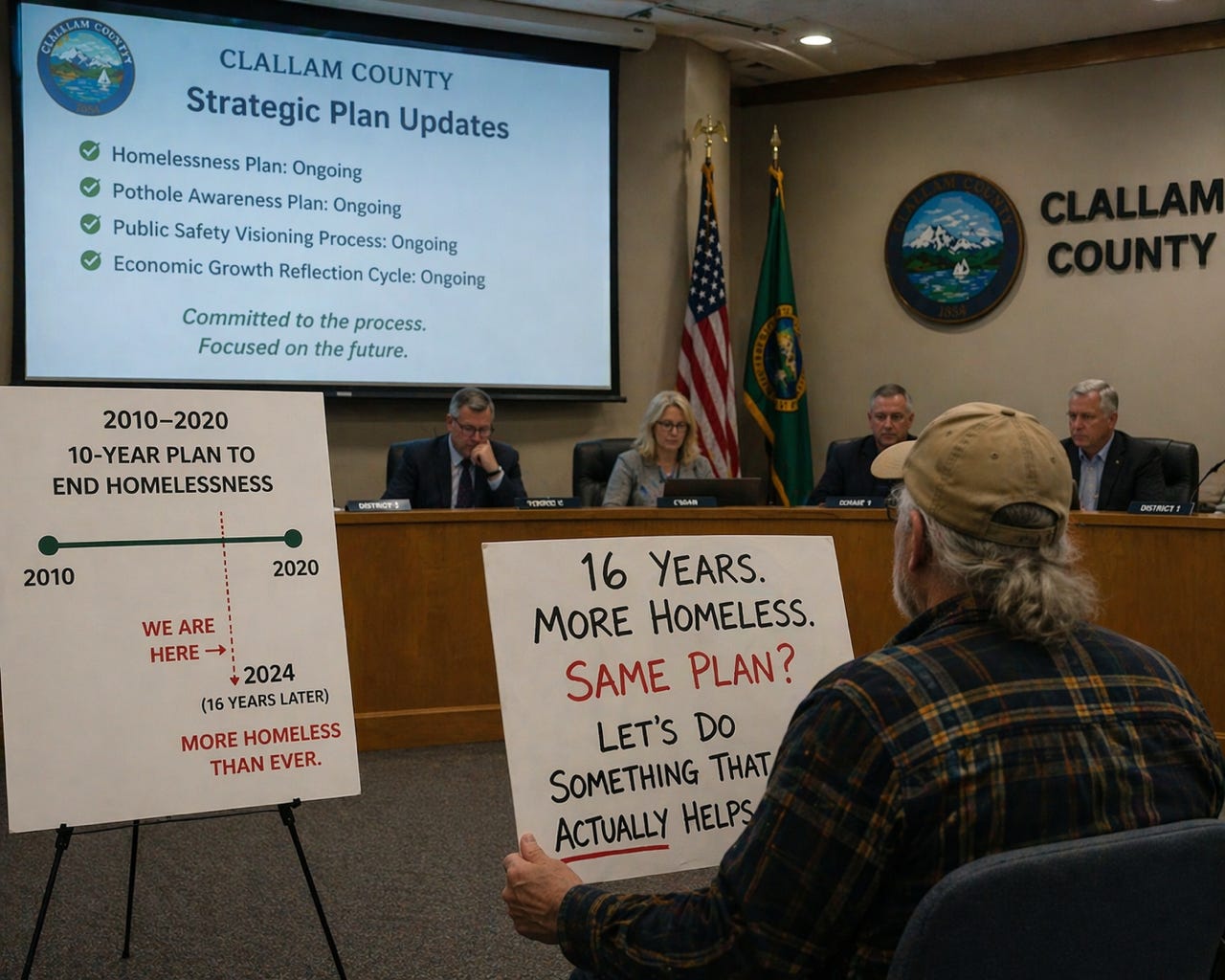
County Celebrates Success of 10-Year Plan by Extending It Indefinitely
Officials confirm timelines are flexible, outcomes are interpretive, and progress is best measured in continued effort
By the Strait Shooter Staff
CLALLAM COUNTY — After more than a decade of sustained planning, Clallam County officials this week reaffirmed their commitment to long-term solutions by announcing a bold new strategy: continuing to plan.
Originally launched in 2010 as a 10-year effort to address homelessness, the initiative has since evolved into what leaders describe as a “living framework,” now entering its 16th year of active consideration.
“We never said which 10 years,” one official clarified. “The important thing is that we’re still engaged with the concept of eventually resolving it.”
Proven Model Expands to New Areas
Encouraged by the durability of the approach, the county is reportedly exploring similar long-range initiatives for other community concerns.
Among the proposals:
15-Year Pothole Awareness Plan: Focuses on identifying, mapping, and discussing potholes, with repairs tentatively scheduled for a future phase.
20-Year Public Safety Visioning Process: Aims to better understand safety through a series of listening sessions, followed by additional listening sessions to reflect on the first set.
12-Year Economic Growth Reflection Cycle: Designed to study why businesses struggle locally, with findings expected shortly after most of them have closed or relocated.
Community-Centered Process
Officials emphasized that these plans prioritize inclusivity and process over rushed outcomes.
“We want everyone to feel heard,” said a project coordinator. “Even if nothing changes, people will know their input was carefully documented.”
Residents have noted that meetings remain well-attended, particularly by those interested in watching how many times the same ideas can be reintroduced under slightly different titles.
Measurable Progress
When asked how success is tracked, officials pointed to several key indicators:
Number of meetings held
Pages of reports generated
Consistency of terminology across documents
“Metrics matter,” one official said. “We’ve never had more alignment around the language of the problem.”
Looking Ahead
Leaders say the next phase will focus on refining existing plans while developing new frameworks to ensure continued momentum.
“We’re not standing still,” an official said. “We’re actively maintaining forward-looking discussions about moving forward.”
At press time, the county confirmed it is considering a 25-year strategic roadmap to streamline the planning process, with early drafts expected shortly after the current planning cycle concludes.
Forks Rain Starts Arriving in Scheduled Intervals; Locals Miss the Chaos but Appreciate the Calendar Invites
Port Angeles Crab Festival Booths Required to Serve Symbolic Portions; Butter Available Only as Concept
Little Oklahoma Introduces Rotating Reality Schedule; Tuesdays Now Designated “Optional”
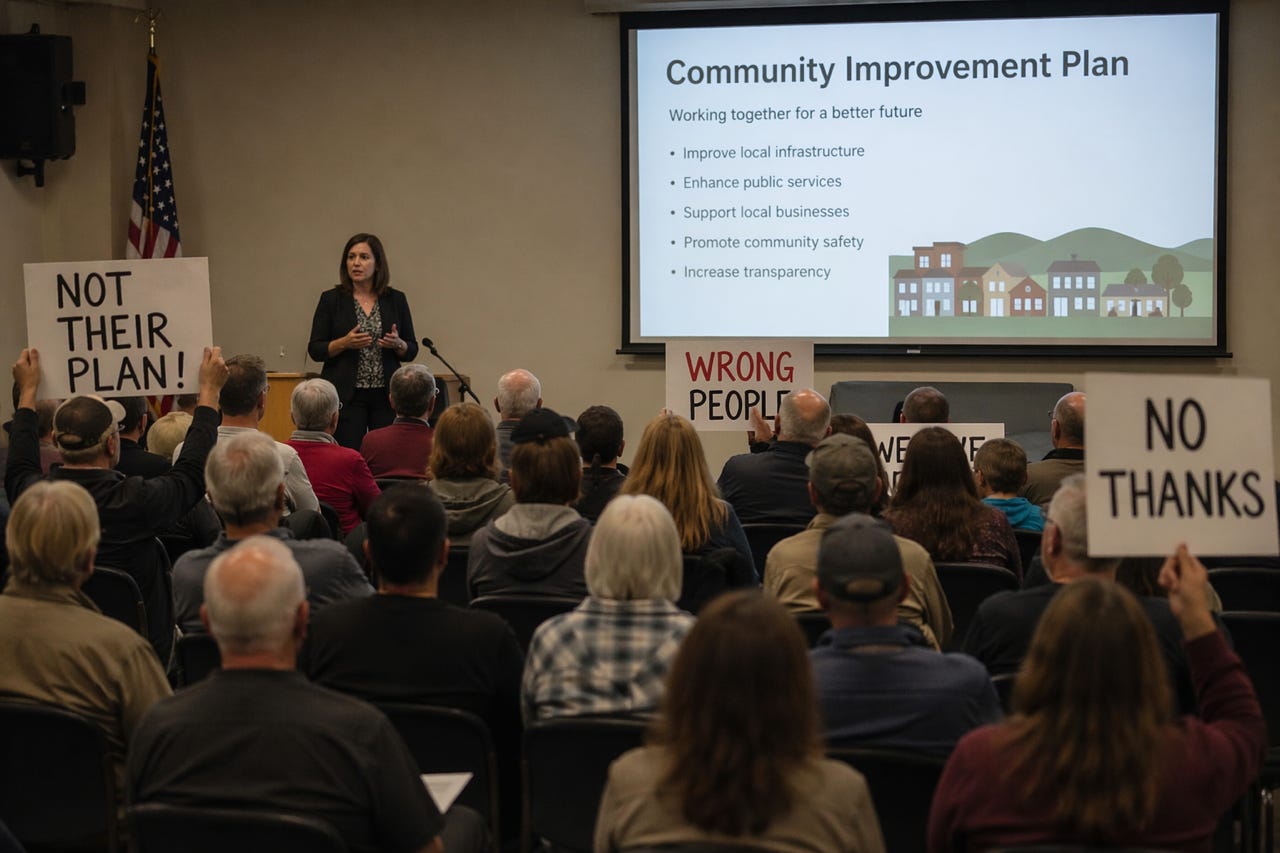
County Residents Confirm “Progress” Is Acceptable, Provided It Comes From Their Side
Local unity effort derailed after participants discover agreement is less important than who they disagree with
By the Strait Shooter Staff
CLALLAM COUNTY — A growing number of residents have reportedly taken a firm and principled stand against any and all positive change, provided it originates from someone they already dislike.
The trend, which analysts describe as “deeply committed inconsistency,” has become increasingly visible at public meetings, community forums, and comment sections — where proposals are evaluated not on their merit, but on whether they can be traced back to the “wrong people.”
“I’m all for improving things,” said one resident, who later clarified that improvement must be “properly sourced.” “If my side had suggested it, I’d support it immediately. But since they did, it’s obviously flawed, dangerous, and possibly illegal.”
Observers note that many of the rejected ideas — ranging from infrastructure fixes to basic community services — were previously supported by the same individuals when framed differently or proposed under a different banner.
“It’s not hypocrisy,” the resident continued. “It’s consistency in opposition.”
Progress, But With Conditions
Efforts to introduce collaborative solutions have struggled to gain traction, as residents increasingly prioritize ideological alignment over tangible outcomes.
One recent initiative aimed at improving local conditions reportedly collapsed within minutes after participants began identifying who originally supported the proposal.
“It started off great,” said an attendee. “People were nodding, agreeing, even taking notes. Then someone asked, ‘Wait — who proposed this?’ and the whole thing just shut down.”
Within seconds, the proposal was reclassified from “common sense” to “deeply concerning.”
The Opposition Standard
Local experts have identified a consistent evaluation method among residents:
If “our side” proposes it → visionary, long overdue
If “their side” proposes it → suspicious, reckless, probably a trap
This framework has proven effective in maintaining ideological purity, though less effective in accomplishing anything measurable.
“We’ve achieved remarkable consistency,” said one observer. “Nothing gets done, but at least no one feels like they compromised.”
Community Response
Attempts to encourage cooperation have been met with cautious resistance, particularly from individuals concerned that agreement could be misinterpreted as weakness.
“You don’t want to be seen agreeing with them,” said another resident. “Next thing you know, you’re accidentally solving problems.”
As a precaution, some residents have begun preemptively opposing ideas before fully understanding them, ensuring they remain aligned with their preferred stance regardless of content.
Looking Ahead
Despite ongoing gridlock, community leaders remain optimistic that progress may eventually occur — once a solution is proposed by someone universally approved, widely trusted, and somehow not affiliated with any identifiable group.
Until then, residents have reaffirmed their commitment to a system that prioritizes loyalty over outcomes, ensuring that while nothing improves, at least the correct people remain opposed.
“We’re not against change,” one resident emphasized. “We’re just very selective about when it’s allowed to work.”
Clallam Bay Fog Reclassified as “Guidance Medium”; Residents Asked to Interpret It Correctly
SunLand Golf Balls Begin Filing Flight Plans; Sand Traps Now Offer Emotional Debriefings
Olympic National Park Trees Asked to Stand in More Cooperative Arrangements; Moss Declines to Comment

To the Editor,
I regret to inform the public that I have recently taken independent action regarding a campaign sign belonging to one Jake Seegers, and after careful reflection (and several hours of staring directly at the sun for clarity), I believe the community deserves to know why.
First, understand this: Jake Seegers is not operating under standard human constraints.
I have seen the signs — literal and otherwise.
The smile? Too symmetrical.
The posture? Suspiciously balanced.
The campaign messaging? Almost… rehearsed, as if translated.
This is not normal behavior for a local candidate. This is interplanetary discipline.
Now, I will admit, I may have acted prematurely when I removed his sign from its rightful place near the intersection. In hindsight, destroying political signage is not the correct course of action, and I encourage others not to follow that path. However, my concern remains: the public is not asking the right questions.
Where is Jake really from?
Why does he avoid discussing citrus procurement logistics?
And why — this is critical — has no one accounted for the increasing disappearance of orange juice from local grocery shelves?
Coincidence? Or fuel source?
I have reason to believe Mr. Seegers is attempting to consolidate influence in order to secure access to municipal-level citrus reserves, which will then be converted into propulsion energy for what I can only describe as “rocket sneakers.” I know how that sounds. I also know what I saw: a brief, unexplained burst of speed during a recent public appearance that defied basic human biomechanics.
You may laugh now. Many have.
They laughed when I warned them about the synchronized blinking at council meetings. They laughed when I charted the correlation between voter outreach and sunrise angles. But the pattern is there, and it is tightening.
He must be stopped.
Not through vandalism, not through chaos — but through vigilance. Through questions. Through refusing to accept that everything presented to us is as ordinary as it appears.
If I am wrong, then we lose nothing by asking.
If I am right, then we are already several steps behind a man who does not need shoes to move the way he does.
Sincerely,
Concerned Citizen (and currently monitoring the juice aisle)

The JST already owns the land in question equal to the rest of us USA citizens. The only reason I see for their having exclusive ownership is a large scale aquaculture operation for JST benefit only.
Good morning SS,
awesome article today!
You might be related to Jake needing citrus fuel 😭
25 more years and the plsnners may come up with another outdated solution.
I hope you two have a great day...