
Tuesday Dysfunction Issue
The latest trends in Clallam County that no one asked for but everyone is paying for


Olympic Peninsula Sasquatch Tribe Breaks Centuries Of Silence To Complain About Human Encampments
“Frankly, The Forest Used To Smell Better,” Says Tribal Elder While Unfolding Tourism Revenue Charts
By the Strait Shooter Staff
OLYMPIC PENINSULA — In what wildlife officials are calling “an unprecedented interspecies media event,” a reclusive tribe of Sasquatch inhabiting the forests of Clallam County agreed Tuesday to a rare candid interview with a reporter from the Strait Shooter, using the opportunity not to discuss their existence, but to express mounting frustration over illegal encampments, widespread litter, and what they described as “an unacceptable amount of human feces appearing where berries used to be.”
The interview took place at an undisclosed location deep within the Olympic foothills after several weeks of negotiation and the ceremonial exchange of smoked salmon, batteries, and a Coleman lantern allegedly stolen from a campground near Lake Crescent.
“We have tolerated the humans for many years,” said Sasquatch elder Grothar through a translator retained by the newspaper’s outdoors section. “We accepted the hiking. We accepted the mountain bikes. We even accepted the podcast hosts whispering into night-vision cameras. But now every ravine contains six propane tanks, a broken office chair, and a man screaming at a fern.”
According to the tribe, conditions within several lowland forest corridors have deteriorated so significantly that younger Sasquatch are beginning to migrate deeper into the mountains to avoid stepping on discarded needles and piles of wet clothing tied inexplicably to trees.
“We are woodland creatures,” Grothar continued while gesturing toward a laminated chart entitled Human Waste Encroachment Trends, Q1–Q4. “If one chooses to live like an animal, then one must do so properly. Build a shelter. Respect the forest. Eat roots. Do not leave behind twenty-seven bicycle frames and half a microwave.”
The tribe clarified that their criticism was not directed at poverty itself, but rather at what they called “the chemically enhanced suburban collapse currently unfolding in every ditch west of Sequim.”
“If humans wish to return to nature, we support this spiritually,” explained tribal historian Murr, seated beside what officials later confirmed was a stolen park bench. “But nature traditionally involves fewer catalytic converters and much less yelling at invisible maritime law enforcement.”
County officials responded cautiously to the interview, with Clallam County administrators acknowledging the Sasquatch community had “raised several valid experiential concerns,” while also emphasizing the importance of maintaining “inclusive outdoor stakeholder dialogue.”
“We appreciate hearing directly from historically marginalized forest entities,” said Deputy Director of Outdoor Equity Sarah Penley in a statement released Tuesday. “The county remains committed to balancing the needs of residents, unhoused individuals, wildlife, cryptids, and grant-funded consultants.”
Penley confirmed the county is currently exploring a pilot program that would designate portions of the Olympic National Forest as “shared transitional habitat zones,” allowing campers, wildlife, and mythical hominids to coexist through “mutual respect and trauma-informed trail etiquette.”
The proposal reportedly includes multilingual signage encouraging residents to avoid dumping trash in streams “actively used by elusive bipedal forest guardians.”
The Sasquatch tribe, however, expressed skepticism that additional signage would improve conditions.
“You people put signs everywhere,” said Grothar. “There are signs saying not to feed bears directly beside refrigerators dumped into creeks.”
Of particular concern to the tribe was what they described as a sharp decline in Sasquatch-related tourism, historically a quiet but important economic engine throughout the Olympic Peninsula.
According to data compiled by the tribe’s Department of Woodland Commerce, annual Sasquatch hunter traffic has fallen nearly 38% over the last five years, while blurry nighttime photograph encounters have dropped to their lowest levels since 1997.
“We used to have visitors from Germany, Ohio, even Tacoma,” said Murr, pointing to a hand-drawn graph burned into a cedar plank. “They came seeking mystery. Now they arrive, see a pile of burning tires near Forks, and leave believing they have already encountered the region’s dominant cryptid.”
Local tourism officials acknowledged the downturn, noting that many visitors now struggle to distinguish between traditional Sasquatch habitat and what one travel blog recently described as “an open-air municipal collapse stretching from Port Angeles to Aberdeen.”
“There was a time when hearing unexplained screaming in the woods generated excitement,” said one tourism coordinator. “Now tourists just assume somebody is fighting a shopping cart.”
At press time, the Sasquatch tribe confirmed it would retreat from public life once again after discovering reporters had left behind three coffee cups, two vape cartridges, and a Lime scooter at the interview site.
Editor’s Note: After publication of this story, Strait Shooter management confirmed staff reporters returned to the interview site to retrieve the abandoned coffee cups, vape cartridges, and Lime scooter, only to discover Clallam County had already designated the area a “temporary culturally activated micro-encampment.” Reporters were subsequently required to complete a six-week environmental impact review, attend a restorative listening circle moderated by Peninsula College interns, and apply for a recreational access permit before being allowed to recover the scooter, which by then had reportedly been appointed to an advisory board on sustainable woodland transportation.
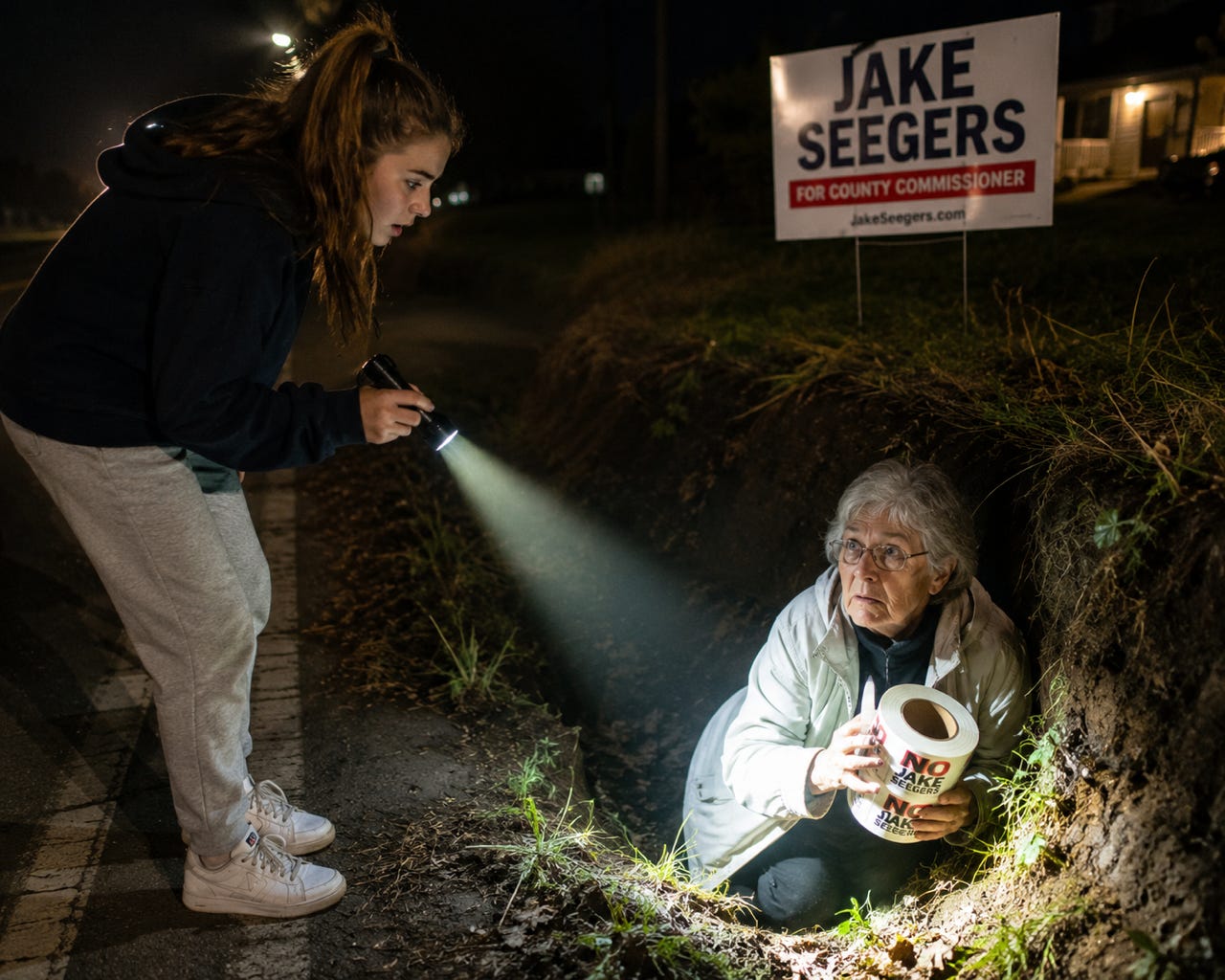
Sequim Grandchildren Establish Emergency Intervention Program For Grandparents Addicted To Anti-Jake Seegers Activities
Support meetings reportedly include sticker amnesty bins and supervised exposure to unaltered campaign signs
By the Strait Shooter Staff
SEQUIM — Following a series of increasingly bizarre incidents tied to the Clallam County commissioner race, local grandchildren have launched an intervention and recovery organization for elderly residents unable to stop stealing Jake Seegers campaign signs or placing anti-Seegers stickers on random public objects throughout Sequim.
The new organization, Grandchildren for Responsible Elder Containment, was formed after several local youths realized they were all dealing with nearly identical situations involving politically overactivated grandparents roaming the county with scissors, tape residue on their fingers, and an unsettling knowledge of election sign locations.
“We thought Grandpa was golfing,” said one Sequim teenager. “Turns out he was conducting what he called ‘nighttime democracy maintenance’ along Old Olympic Highway.”
According to witnesses, the problem has escalated dramatically in recent weeks, with older residents allegedly being caught on camera:
Removing Seegers signs under cover of darkness
Applying anti-Jake stickers to utility poles, trash cans, and one porta-potty
Hiding behind ornamental grasses after hearing approaching vehicles
Carrying rolls of stickers in those little hard candy tins old people always have
Pretending to birdwatch while monitoring intersections for campaign activity
The support group now meets every Wednesday evening in the fellowship hall of a Sequim church, where grandchildren are taught how to calmly de-escalate relatives experiencing “acute election-season episodes.”
Workshops reportedly include:
“Grandma, That’s Public Property”: Setting Healthy Boundaries
Identifying the Difference Between Civic Engagement and Tactical Sticker Deployment
Safe Disarmament Techniques For Seniors Carrying Staple Guns
Guided Relaxation After Hearing “I’m Just Defending Sequim”
Reintroducing Grandparents To Hobbies That Don’t Involve County Commissioner Maps
One emotional attendee described discovering his grandmother crawling through roadside brush in a beige windbreaker attempting to “liberate” campaign signs at 6:15 in the morning.
“She froze when the headlights hit her,” he recalled. “Then she slowly laid down in the ditch like a frightened deer.”
The group has also created a formal “Early Warning Checklist” to help families identify when an elderly loved one may be descending into advanced anti-Seegers behavior.
Warning signs include:
Sudden interest in reflective safety vests
Purchasing excessive zip ties at Ace Hardware
Referring to Facebook memes as “intel”
Saying “someone needs to do something” while staring out the living room window
Unexplained possession of 37 anti-Jake stickers
Calling campaign signs “visual tyranny rectangles”
Several grandchildren reported that family members have become so consumed by the election that normal retirement activities have completely disappeared.
“My grandfather used to carve driftwood,” said one attendee. “Now he just drives around Sequim in a Subaru muttering about independent candidates and suspicious roundabouts.”
Local residents say sightings of politically activated retirees have become increasingly common near major intersections, where older citizens allegedly linger in lawn chairs “monitoring sign integrity conditions.”
One resident described observing an elderly man riding a mobility scooter slowly past a Seegers sign while holding a spray bottle labeled “weed killer,” though authorities later confirmed it was actually prune juice.
Not everyone supports the intervention effort. Several seniors condemned the group as “anti-freedom propaganda” and insisted the sign removals are part of a broader patriotic duty.
“Nobody’s stealing signs,” said one local retiree while unsuccessfully attempting to peel an anti-Jake sticker off his own pant leg. “We’re simply redistributing visual clutter.”
At press time, organizers confirmed they were seeking grant funding for a new supervised recovery ranch where affected grandparents can safely re-enter society through low-risk activities like birdwatching, pickleball, and yelling at clouds instead of campaign signage.

Know Your Community: The Boofing Alley
County Leaders Praise “Low-Impact Recreational Corridor” As Residents Continue Power-Washing Shopping Carts Out Of Storm Drains
By the Strait Shooter Staff
PORT ANGELES — Calling it “an innovative example of unmanaged community resilience,” officials in Clallam County this week unveiled a new public-awareness campaign encouraging residents to “better understand the cultural significance” of a series of hidden downtown alleyways where sustained boofing activity has reportedly flourished for years under what county administrators described as a “hands-off wellness framework.”
The campaign, titled Know Your Community, includes laminated informational placards, a downloadable walking map, and a proposed self-guided audio tour explaining the history of several narrow corridors behind Port Angeles businesses where, according to city records, tarp structures, propane tanks, stripped bicycles, and at least one upside-down recliner have formed what planners called “a semi-permanent behavioral ecosystem.”
“Too often, residents see these alleyways and immediately think, ‘Why is there a mattress on top of a burned shopping cart?’” said Deputy Community Harmonization Director Elaine Rudd during a Tuesday press conference held beside a visibly smoking dumpster behind a closed teriyaki restaurant. “What we’re asking people to do instead is pause and recognize this as a valid form of alternative urban expression occurring directly next to their workplace.”
According to sources within the county, officials first became aware of the scale of the issue after a public works employee attempting to unclog a storm drain reportedly discovered “what appeared to be an entire living room configured around a traffic cone.”
In response, the Port Angeles City Council commissioned a 218-page consulting report recommending the city avoid “criminalizing visible alleyway pharmacological enthusiasm” and instead focus on “relationship-based corridor stewardship,” a policy approach involving occasional eye contact and the installation of a decorative mural reading You Matter above an area residents say routinely catches fire.
“The data clearly shows that enforcement alone does not solve the problem,” said consultant Bryce Menninger, whose Seattle-based urban policy firm received $480,000 to study the alleyways from the lobby of a waterfront hotel. “That’s why we’ve recommended a more compassionate model where residents continue cleaning human waste off loading docks themselves while the county develops a twelve-year equity roadmap.”
Officials confirmed the county also plans to designate several of the most active corridors as “Low Barrier Transitional Gathering Alleys,” allowing outreach workers to distribute bottled water and pamphlets explaining where outreach workers can be found.
Residents expressed cautious frustration with the initiative.
“I just wanted to throw away cardboard behind my store,” said local business owner Dana Hilstrom, pausing briefly as a shirtless man attempted to dismantle a parking meter with a hammer nearby. “Now there’s apparently an interpretive sign explaining that the screaming at 3 a.m. is part of a larger conversation about housing.”
Many locals noted that the alleyways have become increasingly difficult to avoid after officials installed brightly colored wayfinding arrows downtown directing tourists toward what the city brochure calls “authentic grassroots activity nodes.”
“It’s humiliating,” said one resident who asked not to be named after being informed anonymity now requires a permit. “You’ll be walking your kids to get ice cream and suddenly there’s a county employee with a clipboard explaining that an unconscious man in a sleeping bag represents a challenge opportunity.”
Still, county leaders defended the approach, arguing that public discomfort reflects outdated expectations regarding sidewalks, storefront access, and whether garbage should remain inside containers.
“We understand some community members are concerned,” County Administrator Greg Vann stated in a press release Tuesday. “But it’s important to remember these alleyways are part of a vibrant civic tapestry that also includes fentanyl smoke, detached bicycle wheels, and three men yelling at a crow.”
The statement further announced the county’s upcoming “Alley Equity Summit,” where residents will be invited to participate in listening sessions held approximately fifteen feet away from an active encampment officials confirmed they are “continuing to monitor philosophically.”
At press time, city crews had reportedly spent $62,000 pressure-washing one alley clean enough for officials to unveil a new plaque declaring the corridor “a shared space of healing, visibility, and ongoing public urination.”

Another winning edition!
more reality than satire here in Port Angeles:
Still, county leaders defended the approach, arguing that public discomfort reflects outdated expectations regarding sidewalks, storefront access, and whether garbage should remain inside containers.
“We understand some community members are concerned,” County Administrator Greg Vann stated in a press release Tuesday. “But it’s important to remember these alleyways are part of a vibrant civic tapestry that also includes fentanyl smoke, detached bicycle wheels, and three men yelling at a crow.